- Home
- Meet the JR
- Fun & Games
- Discovery
- About
- Multimedia
- Blog
1 week 3 days from now
Professor, Univ. of Massachusetts—Amherst, Amherst, Massachusetts
Dr. Leckie has been involved in scientific ocean drilling since 1981 when he sailed as a foraminiferal biostratigrapher on DSDP Leg 79. Since then, he has sailed on five ODP Legs: 101 (Bahamas), 130 (Ontong Java Plateau), 165 (Caribbean; co-chief scientist), 198 (Shatsky Rise), and 210 (Newfoundland Basin). Dr. Leckie has been actively involved in School of Rock teacher workshops and programs since 2005.
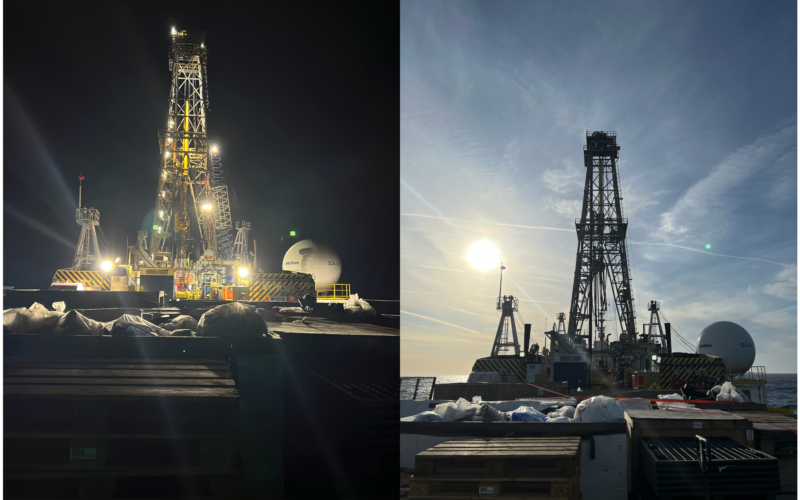
Hi crew: This will have to be my last picture. We are 100 nautical miles from Honolulu. Yesterday I forgot to mention an important piece of information about working on the JR: everyone works 12-hour shifts. On a typical expedition, most people are midnight to noon or noon to midnight (my favorite shift has always been midnight to noon; a good sunrise always makes the second half of my shift seem to go faster). So besides science, what do we do? We eat!! Because the ship is a hive of activity 24 hours a day, there are meals being served around the clock.
Hi crew: Today’s picture is a composite that could be entitled “one more core." This shows the marine technicians, women and men, young and older, taking the initial steps of processing a 9.5-m core. First, by carefully measuring the core, cutting it into 1.5-m sections, and labeling each section, then bringing the sections into the lab where they are logged into the computer and placed in a rack where they must remain for at least 4 hours to thermally equilibrate.
Hi crew:
We’re trying to get to Honolulu, but the winds and the currents are against us! We’ve moved out of the zone of the Intertropical Convergence Zone (ITCZ) where the Northeast Trade Winds converge with the Southeast Trade Winds. This clash of air masses causes the warm moist air to rise
Hi crew: Yesterday we saw the tiny calcareous nannofossils that makeup the major portion of calcareous ooze. These phytoplankton are so small you can’t even see them with your naked eye, yet they accumulate to great thickness in the deep-sea. Not all the microfossils are so small.
Hi crew: So what is “ooze” anyway? Well, there are two flavors:siliceous ooze and calcareous ooze. There are many, many types of microscopic organisms that live in the sunlit surface waters of the world ocean (don’t drink the water!). But some produce mineralized hard parts that preserve to the sediments; that is why geologists study these beasts.
Hi crew: After the cores have passed along the MST track, Natural Gamma analyzer, and Thermal Conductivity, then the sections are split down the middle. One half is called the Archive Half, the other is the Working Half.
Hi crew: Scientific ocean drilling is much different than other means of sampling seafloor sediments. For example, box cores, gravity cores, piston cores and the like collect a single core or sample of sediments.
Hi crew:
I think one of the coolest things about the JR is the moon pool. The moon
pool is the large opening in the center of the ship that allows the drill
string, re-entry cones, and other equipment to pass through to the ocean
below. It is literally a large opening in the ship (probably close to 20 ft
across) with big heavy doors on the deck side that keeps it more or less
Hi crew: The JR is capable of staying in one place for an extended period of time so that it can core into the seafloor. Besides the 2 main screws at the stern of the vessel for moving forward, there are 5 thruster pods, each with 2 propellers, located around the perimeter of the ship. These thrusters are lowered when we arrive on station.
Hi crew:
The 1.5-m sections of core are now brought inside the lab where they are allowed to equilibrate with ambient room temperature on a rack(see inset
Copyright © 2008–2010 Ocean Leadership. All rights reserved. Privacy Policy
site by velocity7.com