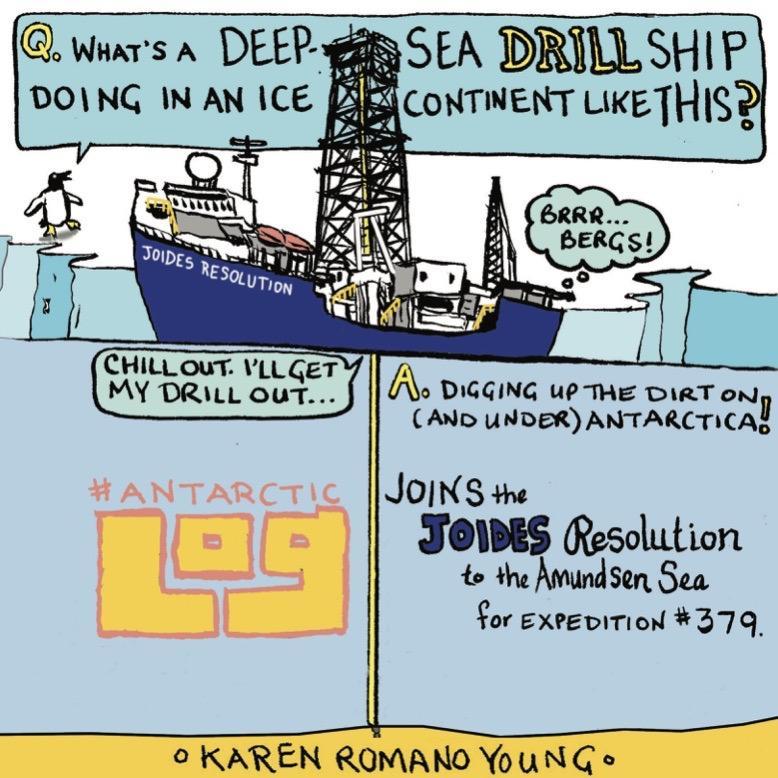
The JR is currently steaming full-speed from its last port call in Hobart, Australia at the end of the Wilkes Land Expedition to Victoria, BC, where it will spend a few months undergoing scheduled maintenance. Watch for photos from the ship in Victoria!
The next expedition is Juan de Fuca Hydrogeology and will be leaving the port of Victoria at the beginning of July with an amazing education and outreach team on board.
Captain Alex
How does dynamic positioning work?
The JR’sDynamic Positioning System (DP), supported by 12 powerful thrusters and 2 propellers, uses computers to maintain the ship over a specific location while drilling in waters as deep as 8,200 meters (5 miles, 27,000 feet). The desired position for ocean drilling activities is entered into the DP computers, then data from two global positioning systems, better know as GPS, and one hydro acoustic beacon on the seabed are fed into the DP computers to give a real time position.
Mike Storms is currently serving as the JR’s operations superintendent on board the ship. He began working with the scientific ocean drilling program right out of college in 1970, with no idea that it would become his life’s work! He has sailed on more than 42 expeditions over the years in a whole variety of roles, but his favorite is the one he is doing right now – Operations Superintendent. He loves the opportunity to plan and coordinate scientific expeditions, working with the scientists on new and cutting edge science, being in the liaison role between the drilling, marine crews, and scientists, and sailing with people from countries all over the world. It's an incredibly exciting and rewarding job that never gets old.
When he’s not sailing, he likes to spend time with his wife and grandchildren as often as possible, Aggie basketball, working around the house, and hopefully soon puttering around with his 67' Chevy Camaro dream car!
From Mike Storms on the Hobart to Victoria transit:
We continue underway for Victoria B.C. on a north easterly course of 35° at an average speed of 9 knots (see challenge question below) with 130 turns on each shaft. We are experiencing a nominal 15 kt headwind and strong current off the starboard beam slowing our SOG. You might find it interesting to know we're steering 45° to make good a 35° course. It's kind of like being pushed sideways by a really big wind and having to make up for it by walking in a different direction.
This newsletter is brought to you by The Consortium for Ocean Leadership and Deep Earth Academy. Ocean Leadership is a nonprofit organization representing 97 leading ocean research and education institutions, aquaria and industry. The organization also manages ocean research and education programs in areas of scientific ocean drilling, ocean observing, ocean exploration, and ocean partnerships. Deep Earth Academy is the education arm of the scientific ocean drilling programs at Ocean Leadership. Deep Earth Academy uses exploration of the world around us as a model and strive to help students become better decision makers, problem solvers, science-literate citizens and stewards of our planet.