Riding the Ring of Fire – OBS/CTD Operations
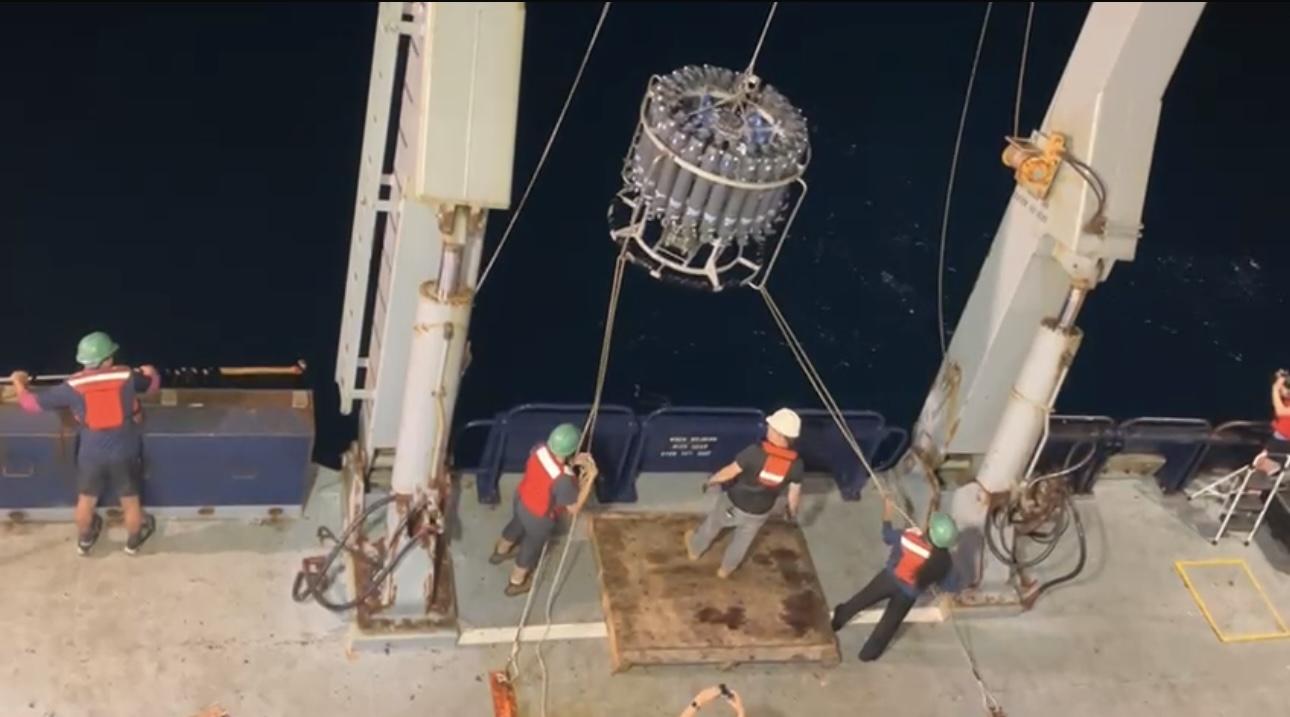
Hi everyone!
I’m currently writing from the research vessel Marcus G. Langseth, along our route from San Diego to the Galápagos Islands.
Our mission? To explore the dynamic geology of the Ring of Fire, one of the most tectonically active regions on Earth. This area, known for its earthquakes and volcanic activity, offers a perfect natural laboratory to study Earth’s inner workings and I’m lucky to be part of a team doing just that.
Over the past 24 hours, we’ve deployed our CTD (Conductivity, Temperature, Depth sensors) and OBS (Ocean Bottom Seismometers) into the deep Pacific. Each CTD cast helps us collect vital information about the ocean’s physical properties, while the OBS units rest on the seafloor to record seismic data that will reveal what’s going on beneath Earth’s crust. It’s fascinating to see how every part of the operation. From planning and deployment to recovery. This all requires precision, teamwork, and a deep respect for the ocean.
Life aboard the Langseth is a unique experience in itself. The ship is constantly buzzing with activity! Researchers analyzing data, engineers monitoring instruments, and students like me soaking in every moment. Between shifts, I’ve spent time getting to know people from all over, each with a shared passion for science and discovery.
As a future science educator, I can’t wait to bring these real world research experiences into my classroom and inspire students to see science not just as facts in a book, but as a living, breathing process of exploration.
This journey has only just begun, and we’ll be sharing more updates as we get closer to the Galápagos. Stay tuned!
— Shaznee Pittman
Student Researcher & Future Science Educator
Aboard the R/V Marcus G. Langseth
#NSFfunded
